
Why stablecoin checkout SDKs matter
Traditional credit card processing leaves significant value on the table for merchants. High interchange fees, cross-border friction, and delayed settlement times create a costly barrier to efficient commerce. Stablecoin checkout SDKs solve these structural inefficiencies by enabling near real-time settlement at a fraction of the cost.
The primary advantage lies in speed. While traditional banking rails often take days to clear funds, stablecoin transactions settle in minutes. This acceleration improves cash flow and reduces the working capital tied up in pending transactions. For high-volume merchants, this difference between "settled" and "available" is not just technical—it is financial.
Beyond speed, stablecoins offer programmability. Through smart contracts, payments can be automated and verified without manual intervention, reducing administrative overhead. Major payment processors like Checkout.com have integrated stablecoin support, signaling that this is no longer a niche experiment but a viable infrastructure layer for modern ecommerce.
TechnicalChart symbol="BINANCE:USDTUSDT" chartStyle="line" interval="1D" indicators='["volume"]'
The shift toward stablecoin checkout SDKs is driven by the need for lower fees and faster conversion. By removing intermediaries, merchants retain more revenue per transaction. As the market matures, these SDKs will likely become standard components of the digital commerce stack, offering a more efficient alternative to legacy payment methods.
Top stablecoin checkout SDKs for 2026
Choosing the right SDK depends on your team's engineering capacity and your target market's payment preferences. The leading providers offer distinct trade-offs between integration speed, blockchain support, and fiat settlement capabilities.
Stripe
Stripe remains the standard for merchants prioritizing ease of integration and fiat off-ramps. Their stablecoin solution allows you to accept USDC and USDT via the existing Payment Element or Optimized Checkout Suite. This approach requires minimal engineering lift, as Stripe handles the blockchain interactions and settles funds directly into your bank account in USD, EUR, or GBP. It is the safest choice for traditional e-commerce businesses that want to offer crypto payments without managing wallet infrastructure or volatility risk.
Crossmint
Crossmint focuses on reducing friction for end-users by allowing them to purchase digital assets with credit cards, eliminating the need for a pre-funded crypto wallet. Their Digital Asset Checkout API supports hosted, embedded, and headless integrations, making it flexible for various frontend architectures. While primarily known for NFT sales, their checkout infrastructure is robust for token payments. Crossmint is ideal for Web3-native platforms that want to onboard users who are new to crypto and need a seamless on-ramp experience alongside their checkout flow.
Eco
Eco provides a developer-first SDK designed for building custom payment flows on-chain. It supports a wide range of stablecoins and blockchains, offering greater flexibility for DeFi applications and complex payment ecosystems. Unlike hosted solutions, Eco gives you more control over the user experience and transaction logic, but it requires more engineering effort to implement and manage. It is best suited for teams that need deep customization and are comfortable handling the nuances of multi-chain transactions.
PhotonPay
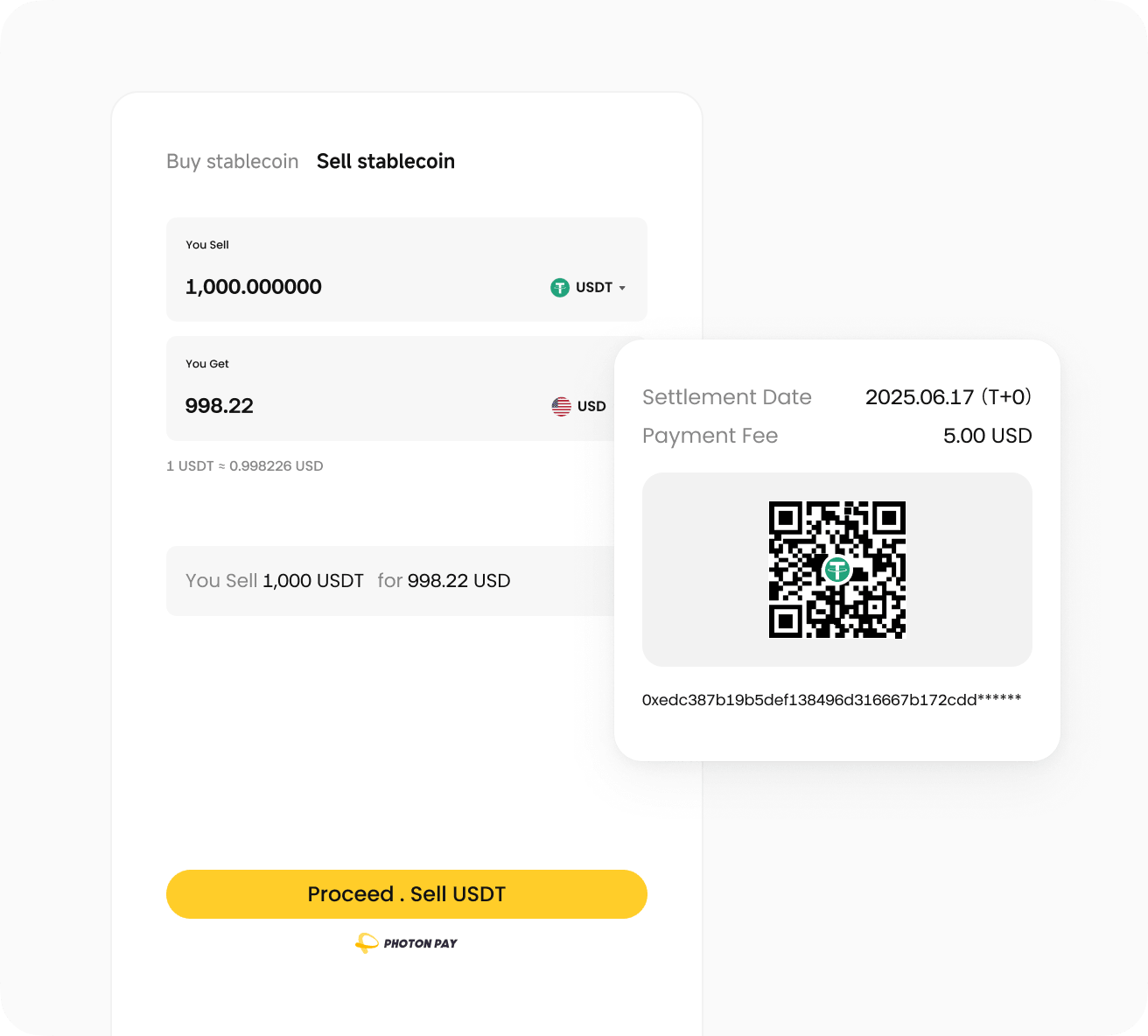
PhotonPay targets global merchants with a focus on fiat settlement and compliance. Their stablecoin checkout accepts USDT and USDC, settling payments in local fiat currencies while providing real-time tracking and global compliance features. PhotonPay is particularly useful for businesses operating in regions with strict regulatory requirements or those needing support for specific local fiat pairs. Their platform emphasizes security and auditability, making it a strong option for enterprises that prioritize regulatory adherence alongside payment processing.
| Provider | Settlement | Integration Effort | Best For |
|---|---|---|---|
| Stripe | Fiat (USD/EUR/GBP) | Low | Traditional e-commerce |
| Crossmint | Crypto/Fiat | Medium | Web3 onboarding |
| Eco | Crypto | High | DeFi/Custom flows |
| PhotonPay | Fiat (Global) | Medium | Global compliance |
Technical integration requirements
Implementing a stablecoin checkout SDK requires a precise technical stack that bridges traditional e-commerce infrastructure with blockchain networks. The process relies on three core components: secure API authentication, real-time transaction verification via webhooks, and automated compliance checks. Each layer must be configured to handle the volatility and finality of on-chain settlements while maintaining the speed expectations of traditional payment processors.
Stablecoin SDKs require API keys to authenticate your merchant account with the provider’s node infrastructure. These keys act as the primary gatekeeper, ensuring that only authorized transactions are processed. You must store these keys in environment variables, never in client-side code, to prevent unauthorized access to your settlement accounts. Official documentation from providers like Chain emphasizes the importance of scoped permissions to limit exposure if keys are compromised.
Unlike traditional credit card payments that settle instantly, stablecoin transactions require on-chain confirmation. You must configure webhooks to listen for specific events, such as payment_received or confirmation_complete. This ensures your order status updates only after the blockchain network validates the transaction, preventing fraud from double-spending or premature order fulfillment. The webhook endpoint must be HTTPS-secured and capable of handling retry logic for transient network failures.
Regulatory compliance is non-negotiable in stablecoin payments. The SDK must integrate with identity verification services to perform Know Your Customer (KYC) and Anti-Money Laundering (AML) checks before allowing high-value transactions. This often involves screening wallet addresses against global sanction lists. Failure to implement these checks can result in frozen funds or legal penalties, making it a critical part of the integration architecture.
Blockchain networks are subject to latency and congestion. Your integration must include robust error handling to manage failed transactions, insufficient gas fees, or network outages. Implement a reconciliation process that periodically checks the status of pending transactions against the blockchain explorer. This ensures that any discrepancies between your internal ledger and the actual on-chain state are identified and resolved automatically.
| Feature | Traditional Payment | Stablecoin Checkout |
|---|---|---|
| Settlement Time | 2-3 business days | Minutes to hours |
| Finality | Chargeback possible | Irreversible on-chain |
| Compliance | Processor handled | Merchant integrated |
| Global Reach | Restricted by region | Borderless |
USDC market performance and trends
USDC (USD Coin) is the dominant stablecoin for merchant checkout, maintaining its peg through a reserve model backed by cash and short-dated U.S. Treasuries. For integration teams, this transparency means predictable settlement values without the volatility risks associated with other digital assets. The coin’s compliance-first approach, overseen by Circle, ensures it meets the regulatory standards required for enterprise-grade payment infrastructure.
Liquidity is the primary advantage for checkout flows. USDC operates across multiple blockchains, including Ethereum, Solana, and Polygon, allowing merchants to choose networks based on speed and cost. This multi-chain presence ensures that funds are always accessible, regardless of the underlying infrastructure a customer uses. The depth of liquidity pools means large transactions settle instantly without significant slippage.
The stability of USDC is best observed in its trading chart. Unlike speculative assets, USDC/USD remains tightly anchored to $1.00, making it a reliable unit of account for invoicing and payroll. The following chart illustrates this stability over the past day, confirming that the asset functions as intended for daily commerce.
No comments yet. Be the first to share your thoughts!